Wednesday, July 30, 2025

Bee expo (Bijenexpo)

The bee expo is hosted in the Kalmthout tourist information centre and can be visited free of charge. Opening times are limited, so check before you go.

In a 23-step trajectory, the bee expo is a rich exhibition of the history, culture, folklore and techniques of beekeeping and honeymaking. There is a wealth of information, but without guide or expert knowledge on the subject, it is a little difficult to access.

Nevertheless, spending a few minutes on each stop, one can easily spend an hour. There is also a small shop offering regional products and a selection of books and comics.

Visited May 2025.

---

ID 633 on the Tourist Map Belgium. Nearby sites are the Suske and Wiske Museum - ID 465 and the Bakkersmolen - ID 201.

Saturday, May 31, 2025

Fortress of Liefkenshoek


Liefkenshoek is the twin fortress to the Fortress of Lillo. These fortresses are located respectively on the left and right banks of the Scheldt river and were strategically positioned to control the access to Antwerp Harbor.

What is there to see or do?

  • Gatehouse - information
  • Officers' residence - now a meeting centre, featuring a panoramic air photo of the Antwerp harbour
  • Experience centre - 12 rooms providing information on various subjects, such as the fortress' role as a medical centre to screen migrants on their way to the USA. It also provides a few rooms on the history of the Waasland region, particularly its fights against the forces of water. 
  • Powder magazine - the oldest building on-site.
  • Lookout tower.
  • Bunkers from WWI
  • Inner rampart dating back to the fortress' 16th century origin
  • Outer dike
On-site is a brasserie for a meal, snack or drink.

Visited May 2025 on a beautiful spring day. Liefkenshoek is local tourism and a bit off the beaten track. Visitors are mainly from Flanders and the Netherlands, occasionally from Germany. Panels and information in Dutch.

---

ID 54 on the Tourist Map Belgium. Nearby is the Fortress of Lillo, connected by De Waterbus. 


Sunday, May 25, 2025

Grote Markt (Antwerpen)

Antwerp’s Grote Markt is undeniably grand, but can we say more about it than beautiful, magical, many details or must-see? Visitor praise might just as easily apply to Brussels’ Grand Place.

So let's compare with Brussels' Grand Place. Both squares are central to city life, settings for events and popular spots for a drink. But Antwerp’s square is more open, less uniform in architectural style, not entirely car-free—and it feels a bit embedded into city life than its Brussels counterpart.

Reviewers list the key sights: the Renaissance-style City Hall, the Brabo Fountain, the rows of guild houses.  Link: https://visit.antwerpen.be/en/grote-markt

This tourist site appears in Nero's comic 'de ring van Balderic' which takes place in Antwerp and shows various other locations (het Steen, the Brabo monument, Lange Wapper, the cathedral, the harbour, ...). Written as a posthumous tribute to Marc Sleen and Nero, the comic has been translated into the Antwerp dialect.

ID #584 on the Belgian tourist map. Within a few hundred meters, the square is surrounded by a host of notable sites.

Monday, May 12, 2025

Bakkersmolen (Essen)


The Bakkersmolen 'baker's mill' is a pleasant, surprising, worthwhile, and highly recommended stop when visiting the area of Essen and Kalmthout. What's there:

  • The mill, built in 1981. Operates on Sundays
  • An adjacent museum of steam machines of various sizes
  • A playground and train for children from 36 months
  • An artisanal bakery with a museum room on baking techniques
  • A brasserie

Visited early May 2025, on a glorious spring day (while the summer season had not yet fully started). Browsing through the mill's 1,000+ reviews on Google Maps is encouraging. Locals use it for a regular outing. The place is also great with kids. Both the brasserie and bakery are appreciated. A visit for all ages, what are you waiting for?

---

ID 201 on the Belgian Tourist Map. A visit to the Bakkersmolen can be combined with nearby sites such as the Bee Expo, 'Bijenexpo' - ID 320 or the museum dedicated to comic strip heros Suske en Wiske - ID 465.

Sunday, May 11, 2025

Lillo - fortress, museum and former polder village

Lillo is a twin fortress with Liefkenshoek across the Scheldt river. These two fortresses were strategically located to defend Antwerp's harbour entrance. 

What can be seen?

  • Significant buildings from the former fortress: casemates, officer houses and the powder magazine. The latter is now a theatre.
  • The Polder Museum, open only on Sunday afternoons.
  • The nearby White Mill 'the unicorn'.
  • Worth mentioning: Lillo is the most northern stop for the waterbus which stops at eight places on its way south to Hemiksem. A day pass can be acquired on-board to visit them all.

Since 2008, Lillo organizes an annual second-hand book sale in summer. The 2025 edition takes place on July 13 and August 10.

The twin fortresses are also part of Antwerp's 'fortress belt', a defence network of over 20 fortifications.

Visited May 2025. This is tourism off the beaten track, suitable for locals, local history enthusiasts or deep explorers of Belgium.

---

ID 633 on the Belgian tourist map. See also ID 284 for the Polder Museum. Other nearby sites within easy driving range are the Fortress of Liefkenshoek (ID 54 - reachable through a toll tunnel), the re-emerging village of Doel (ID 468).

See also Jos van Aerde's website about Lillo Fortress, remnant of a former polder village.

Tuesday, April 29, 2025

Grand Place (Brussels)

The Grand Place in Brussels is the city’s central square, known for its ornate guildhalls, the Town Hall, and the King's House (Maison du Roi). It hosts events such as the Flower Carpet and the Christmas Market. The square has been a UNESCO World Heritage Site since 1998.

ID #1 on the Belgian Tourist Map, it is probably the most reviewed Belgian tourist site on Google Maps (150k+ reviews, average rating 4.7 as of December 2024). It confidently features as one of the top sites in Belgium because of its grandeur and surroundings.

The site is amply described elsewhere, e.g. on the official website of the city of Brussels - https://www.brussels.be/grand-place-brussels. 

The name Grand Place is popular in Belgium. Together with "Grote Markt" in Flemish, it applies to dozens of towns. Among these, the "Grote Markt" in Sint-Niklaas, with its three hectares (7 acres),  has the largest surface area. 

Visited at multiple occasions, normally at least once per year, e.g. for the flower carpet, the Christmas Market or another happening.

---

ID 1 on the Belgium Tourist Map. With over 160,000 ratings, it is one of the most reviewed Belgian tourist attractions. The Grand Place is surrounded by tourist attractions around every corner.

Wednesday, July 24, 2013

Eben-Emael, the Titanic of Fortresses

Fort Eben-Emael was constructed between '32 and '35 as a defense against German aggression. It was one of the most modern fortresses of its time, but unfortunately designed too much with a WWI mindset. It was stronger than anything constructed by the French in the Maginot line or anything by the Germans in the West Wall.

Deemed impregnable by both the Germans and the Allies, it was incapacited within half an hour following a bold attack on May 10, 1940 by a German elite force using glider planes. Thirty hours later, Eben-Emael surrendered.

The current fortress is exploited by volunteers, some ex-military, that spend every effort to keep the fortress alive. Guides lead you through the 5 km of tunnels during a tour of 2-3 hours (depending on how much questions you ask, or how many stories they tell).

This visit is an absolute must, but carefully check the limited opening times to avoid disappointment.

ID 427 on the Belgian tourist map. In the vicinity is the Eben-Ezer tower. a curiosity well worth visiting.

Monday, July 22, 2013

Antwerp's city museum (MAS)

Antwerp is a world port and a great medieval city that hosted two world exhibitions in the 19th century. When it opened its new city museum in 2011, expectations were high. But considering Antwerp's rich historical and maritime heritage, the 'Museum aan de Stroom (MAS)' could have been a little more.

Still, the MAS merits a visit for the architecture of its building and surroundings and for its panorama. From the collection, the visible storage showing a sample of the museum's 180,000 objects is an interesting idea.

The building, the boulevard, the panorama and visible storage are freely accessible. Up to you whether you want to see the permanent collection.

ID #401 on the Belgian Tourist Map. 

Sunday, March 24, 2013

Discovery of dinosaurs


A few weeks ago, we went to the Museum of the Iguanodons in Bernissart. There were not a lot of people in the musuem so we could go around quietly . We were welcomed with ample explanations at the reception. There is a translation text for the panels available in different languages.

The museum is very well organised. It covers mainly the Iguanodons and their discovery in the area. There are many other fossil remains from prehistoric times to admire. In particular, a small collection of petrified trees caught our attention. In summer, you can visit the place nearby where the Iguanodons were found in the 19th century.

A visit takes about an hour. In the main hall you see an authentic skeleton of an iguanodon, explanations on the prehistory, a dinosaur egg, etc. There are 3 additional rooms. Near the entrance there is a small shop.

In Bernissart, coal is mined since 1849. In April 1878, the Iguanodons were found at a depth of 320-350 m. There were 31 complete skeletons as well as 3,000 fossil remains of fish, crocodiles, turtles, ferns and fragments of insects. The remains were particularly well preserved during 130 million years in the clay soil, sealing the skeletons from air and water and protecting them from decay. It took three years to dig up all these fossil remains.

A few facts about dinosaurs
  • Iguanodons weighed approximately 5 tons.
  • The name dinosaur was only formulated in 1841 by Richard Owen.
  • Paleontologists estimate that there were 2,000-3,000 species of dinosaurs, of which currently only 600 are known.
  • Dinosaurs were big but not very smart - they had relatively small brains.
  • Though there are more than 80 theories about the disappearance of the dinosaurs, still ignore the real reason.
  • Mantell, an English scholar found a few teeth from iguanodons and compared them with those of an iguana, hence the name'' iguanodon'' or “tooth of an iguana”. Although scientists subsequently discovered that this interpretation was incorrect, they nevertheless decided to retain the name.
The discovery in Bernissart was particularly important because the 31 whole skeletons of the same species were found for the first time. Before that, scientists had to speculate about dinosaurs on the basis of loose bones and skulls. After Bernissart, they could form a clearer picture of how dinosaurs looked like.

Practical information
You find the museum about a good hour's drive from Brussels, in the Ruelle des Médecins 13, 7320 Bernissart. The museum is open throughout the year. Besides school groups, the museum welcomes about fifteen visitors per day. Bernissart is 15 km from Valenciennes, and is not far from Mons and Tournai. On the way back, you can visit Grand Hornu or Le Pass.
---
ID #316 on the Belgian Tourist Map

Sunday, July 22, 2012

Brussels Museum for Mill and Food


Evere is a village in Brabant with a history dating back at least to the 12th century. Until the 20th century, however, it remained an agricultural village in the vicinity of Brussels, by which it was eventually absorbed.

The mill dates back to 1841, and hosted various industrial activities until it became the “Brussels Museum for Mill and Food” in 2008.

Apart from a small permanent exhibition on milling techniques, the museum hosts each year a temporary exhibition on a food-related theme. Currently, this theme is ‘Sweet Candy’ and it covers the history, folklore, industry and health effects of candy.

This is a visit for all ages. Displays are in Flemish or French.

Thursday, July 19, 2012

Museum of Belgian Endive (Chicory)

Chicory has a long medicinal tradition - it was used by the Egyptians, Greeks and Romans alike. Rembert Dodoens, the great Renaissance botanist lists chicory as a cure for 27 different ailments. The plant exists in 2 main varieties, Cichorium endivia and Cichorium intybus.

The latter variety produces leaves similar to the dandelion. The practice of covering its leaves with earth to bleach them became popular in the 18th century. Following this practice, Belgian endive was accidentally discovered. Around the middle of the century, it was observed that white crops grew on the chicory roots if they remained buried in the ground. This finding occurred in several places almost simultaneously, for example by Frans Breziers, Chief of the Botanical Garden of Brussels.

Anyway, while Frans Breziers may have received more credit than his more obscure co-inventors, Belgian endives are indisputably Belgian (unlike French fries, which may well be of Spanish origin).

The first crops were produced in 1846. In 1873, 500 kg of Belgian endives found their way to the Parisian markets and 10,000 kg in 1913. Other export markets developed, such as the USA and more recently, Japan. Belgian production of endives peaked in the 70s with 125,000 tons, but in the meantime, France has taken over as the world’s largest producer of this delicacy.

The image of Belgian endives as a delicacy stands in sharp contrast with the other use of chicory, i.e. the grinding of its roots to produce a surrogate for coffee. Belgian endives (called ‘witloof’ in Flanders) can be used for a variety of dishes, such as salads, soups, tarts, cakes, and gratins.

The Museum of Belgian Endive (Witloofmuseum) introduces the old techniques for growing the crop, the hard labour in the winter months, the folklore around its cultivation, the process from seed to crop, and much more. Audio guides are available in English, French and Flemish. In the small museum shop, a cooking book is offered dedicated to recipes using Belgian endives.

Near the museum is a restaurant with a menu dominated by endives. If you want to spend even more time, tours are offered, combining the museum with a visit to the horticultural auction and to nearby endive farms, with a pause in one of the nearby restaurants.

Visited in summer 2012. 

---

ID 632 on the Belgian Tourist Map.

Tuesday, July 17, 2012

Rupelmonde - harvesting the power of the tides since the middle ages


If you are new to Belgium, chances are that you haven’t heard yet of Rupelmonde, a small village in the eastern part of Flanders. At the crossing of the rivers Rupel and Scheldt, Rupelmonde was the location of a large moated castle in the 12th century. It served the Count of Flanders in his defense against Holland and Brabant. When Philip the Bold unified Flanders and Brabant in 1389 under the Burgundian Netherlands, the castle lost its military function and was converted into a prison.

It served as such until 1657, after which it was abandoned and quickly decayed. Nobody cared much for it, probably because of the atrocities committed in it during almost 3 centuries. By the 19th century, little remained. In 1817, Baron de Felz had the site cleared and constructed a tower to be used as a hunting pavillon. This tower currently hosts a small museum on Renaissance scientists, with special focus on Mercator, who was born in Rupelmonde 500 years ago.

All that remains of Mercator in the village is a statue and a commemorative plaque at his place of birth. To learn about the great cartographer, it’s probably better to visit the Mercator Museum in nearby Sint-Niklaas.

What is worth the detour when in the neighbourhood, is a 16th century water mill, running on the tides of the river Scheldt. Already in the middle ages, a mill operated on this site. The building dates from 1517. The current, 6-meter wheel was installed in 1924 and is the largest indoor water wheel in Europe. The 8-ton construction can provide 17.5 kW of power.

The mill is unique in Europe and fully operational. Grain is milled about 10 times per month during the tourist season (see calendar).

Monday, July 16, 2012

Belgian Brewers Museum


A beer museum in a country dedicated to beer and situated on the Brussels Grand Place carries great promise. Unfortunately, even without very high expectations, the Belgian Brewers Museum disappoints. What went wrong here?

Well, first of all, the museum is a half-way house between a pub and a museum. However, if you want a pub, the nearby Roy d’Espagne is unbeatable in atmosphere. For a museum, it’s all a bit thin. The Schaerbeek Beer Museum or the Lambic Visitor Center offers a richer experience.

Secondly, the museum lacks space. Space comes at a premium at Grand Place, but only the cellar of the ‘Maison des Brasseurs’ is devoted to the museum, with the rest of the building used for other purposes. The story of beer merits quite a bit more space, especially in Belgium.

If you do visit the museum, you can expect to see a couple of ancient and modern beer making instruments and a few posters on beer-making. You can also watch an image video.

Sunday, June 17, 2012

Coudenberg Palace - Paradise on earth in the 16th century


When visiting the Coudenberg Palace in 1520, Albrecht Durer wrote: “Behind the King’s House in Brussels, I saw fountains, a maze and hunting grounds. Never in my life had I seen anything as entertaining and pleasant. It’s like paradise.”

Thirty years later, Juan Christobal Calvete de Estrella, when inspecting the palace for a royal visit describes it as “truly royal, large enough to house the emperor, princes, queens and ladies of the court together with all the serving officers”.

The palace consisted of a chapel, royal appartments, a banqueting hall, kitchens, administrative offices, … It contained a vineyard, an orangerie, a list field for jousting, a tennis court, hunting grounds, flower gardens, several walled gardens with fountains and artificial grottoes.

The development of this paradise started in the 11th century with a castle. Originally, the palace started as a fort, and was part of the first defensive wall of Brussels. When a second wall was constructed in the 14th century, the Coudenberg lost its military function and the castle was gradually transformed into a palace.

When Brussels became the capital city of the Low Countries, the Dukes of Burgundy and later the Habsburgs adopted the palace as residence. Charles V, the monarch on whose empire the sun never set, but who spent 28 years of his life in the Low Countries, used it as one of his main residences. He was emancipated in it in 1515, and choose it as the location for his abdication in 1555.

Other historic events in the palace include the accession to governance of the Low Countries by Mary of Hungary and the wedding feast of Alexander Farnese.

The palace was mostly destroyed by fire in 1731 and its Gothic remains were taken down four decades to make place for the Royal District, a neo-classical urban development. What remains of the palace is an underground complex that was excavated in 1985.

We can have a good image of what the palace looked like since it shows up in many paintings, drawings and maps. Some of these can be viewed in the Brussels City Museum. This includes even paintings of the interior of the palace, e.g. the Aula Magna and the Chapel, as well as of some of the historic events that took place on its premises.

The visit of the underground complex takes you through the royal apartments, the chapel, the gardens, the Aula magna, Rue Isabelle and ends with the Hoogstraten-Lalaing house. You’ll need lots of imagination to picture Dürer’s paradise on earth, but lively explanations, pictures and even a model of the Palace help you.

Count at least one hour for a quick visit, and 2 hours for a leisure visit. On the premise, there is a great bookshop and a museum cafeteria where you can enjoy a salad buffet based on local products. The facilities and entrance are shared with the BelVue museum (dedicated to the history of Belgium as a country).

Saturday, June 16, 2012

The Musical Instruments Museum

Most children in Brussels, by the age of 12, will have visited the Musical Instruments Museum (MIM) multiple times. The museum is popular for schools, families and birthday parties. It’s a visit for all ages and an absolute must for tourists. Why? The MIM has it all:
  • a museum with an original concept
  • a extensive museum shop
  • an exceptional building
  • a rooftop restaurant with panoramic view, where you can enjoy typical Belgian cuisine
What makes the museum concept original? There are no big text displays with long explanations. The visit is made by headphone. When walking near any of the instruments on display, you’ll hear them play.

Not much more should be written about the MIM. Just go there and experience it yourself.

ID #251 on the Belgian Tourist Map.

Ultimate list of Belgian Tourist Cities

It's often said that there is more to Belgium and the major cities of Flanders and Brabant. But how much more? Here's an attempt to an ultimate list of touristic cities in Belgium. Vote, comment or add your own:

Tuesday, June 5, 2012

The Zimmer tower in Lier - the world's slowest mechanical construction


In the city of Lier, not far from Antwerp, stands the Cornelius tower, a last remnant of the city’s medieval fortification. Today, it is better known as the Zimmer tower, because of the unique clocks it hosts from watchmaker and self-made astronomer Louis Zimmer.

Even if you’re not much interested in clockmaking and telling time, this is a unique visit well worth your while, since it includes three master-pieces with world-wide fame: the Jubilee Clock and Astronomical Studio in the tower, and the Wonderclock in a nearby pavillion.

In total, these 3 constructions have 163 dials, but are driven by only 2 clock mechanisms. Why in the world would one need 163 dials to tell time? What do they show?
  • Measurements of time: of course time itself, in various timezones, as well as day of the month, day of the week, month, season, zodiac, the decimal hour, sideral time, …. Note that we’re well before the electronics age, and all variables are mechanically calculated, driven by 2 mechanisms only.
  • Phenomena driven by time: astronomical phenomena, such as the lunar cycle, distance between earth and sun, earth’s velocity, sunrise and sunset, tides in 10 cities, …
The Wonderclock is a 2041 kg, 4 m high construction developed for the 1935 World Fair in Brussels. In 1938, it was shipped to New York for the 1939 World Fair. Due to the War, it returned to Lier only in 1954. The clock has 93 panels. The time of one revolution varies between an hour and 25,800 years - a variation of 8 orders of magnitude. The panel requiring 25,800 years for one turn is subdivided in 360 degrees and needs 71.66 years to move one degree, making it the slowest mechanism in the world. This panel shows the ‘general precession of the earth’s equinoxes’.

The Jubilee Clock was donated by Louis Zimmer in 1930 to his birth town. It commemorated the 100th anniversary of Belgium. The clock was built into the Cornelius tower which was quickly renamed. It consists of a central panel showing the official time in Belgium, surrounded by 12 panels:
  1. Equation of time
  2. Zodiac
  3. Solar orb and dominical letter
  4. The week
  5. The terrestrial globe
  6. The months
  7. The dates
  8. The seasons
  9. Tides
  10. Moon’s age
  11. Phases of the moon
  12. Moon’s orbit with EPACT
The astronomical studio on the first floor of the tower consists of 9 departments with 57 astronomical representations. It was finished in 1932 as a didactic display for schools, a purpose it serves until today.

Noteworthy
  • Until 1940, Amsterdam operated on a special time zone UT+20’. There were 40 minutes of time difference between Amsterdam and Brussels.
  • The Chinese dial, where the hands turn in the opposite direction.
  • The decimal time: During the French revolution, the day was divided in 10 hours, with each hour having 100 minutes. Midday was 5 o’clock, midnight 10 o’clock. The introduction of decimal time was rather short-lived.
  • Thirteen dials in the astronomical studio show the tides in various cities. There is a time delay between the passing of the moon and the beginning of high water tide, caused by depth, channels and friction of the borders. From Lisbon to Reykjavik, this time difference amounts to almost 16 hours.
  • The Cotsworth calendar was developed n 1902, and proposed in 1932 to the League of Nations. It consisted of 13 months of 28 days each. The 13th month, Sol, is inserted between June and July. A 365th day is added as international Day of Peace. This calendar is a universal calendar, with your birthday falling each year on the same day of the week. We can understand the appeal of this calendar to Louis Zimmer, as it greatly simplified the required mechanical calculations compared to the Gregorian calendar.

Sunday, May 27, 2012

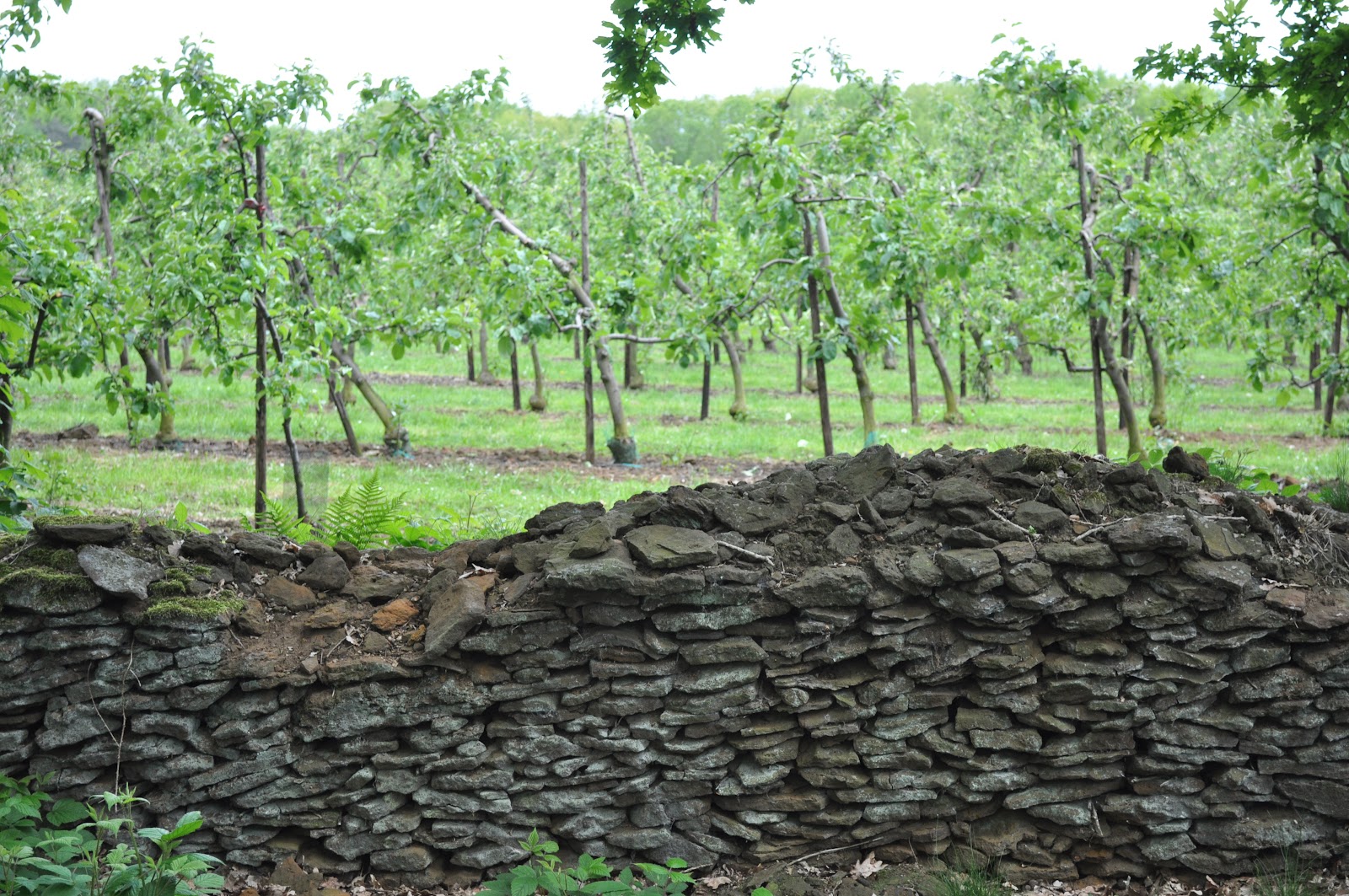
The stone wall of Wezemaal


According to popular belief, the stone wall of Wezemaal goes back to the Middle Ages. Records indeed prove that count Arnold of Wezemaal owned a vineyard back in 1254. Wine growing in the region might even go back as far as the 11th century.

From the 14th to the 16th century, cultivation of wine in the Hageland had its ups and downs. It stopped abruptly in 1570. Competition from the (better) German and French wines, the success of hop beers and a change in climate all contributed to this decline.

From then on, no wine was grown, until J F Audoor, a civil servant from Brussels, obtains permission from the Count of Ursel to start a vineyard. He recruits a viticulturist from Hoei to establish a 6 ha vineyard in 1817. By 1834, already 32 ha are being cultivated. In 1828, a record production of 32500 liter is achieved.

Both King Willem I (before 1830) and King Leopold I (after Belgium’s independence) looked favourably on wine cultivation in Wezemaal, but nevertheless, production stopped again in 1845.

Except for a timid attempt by Adolf Schuler in the thirties, Wezemaal was again without wine culture for well over a century. In 1982, a group of local enthusiasts, with strong support from the municipality, established the association ‘Steenen Muur’ and started 3 vineyards for a total of 0.7 ha. Today, Wezemaal, part of Rotselaar, aims to profile itself as a wine village in Flanders.

So what’s the story behind the wall? It’s not medieval. Instead, it’s a relatively new construction dating from 1814 (one year before the battle of Waterloo). It was constructed to protect the southern slope of the Wijngaardberg (literally “Vineyard Hill”) against the cold north wind. As secondary benefits, it served to keep unwanted animals out, and acted as a demarcation line. The wall was constructed by stapling iron sandstone found on the hill.

Why the need for this wall? At the time, it was believed that wine could not be grown above 50 degrees latitude. Wezemaal is at 51 degrees (approximate latitude of Brussels, Louvain, Cologne), which made its vineyards the most northern ones in Europe in the 19th century.

Despite its northern location, the Wezemaal Wijngaardberg combines several ideal conditions. The southern slope optimally captures sunlights, while the iron sandstones underground store heat that they slowly release at night, so that the soil does not cool down too much. Cool air rolls down the hill and the wind quickly blows morning dew away. These conditions create a suitable microclimate.

Meanwhile, there are plenty more vineyards even further north of Wezemaal, e.g. in the Netherlands, and Wezemaal is no longer Europe’s most northern vineyard. Are these growing wine cultures in Belgium, Netherlands and Southern England facilitated by climate change?

The wall can be visited by a 3 km walk, which takes you through the middle of the vineyards. The wall itself is 1546 m long, and was originally 1.7 meters wide and up to 2 meters tall. Meanwhile, many stretches of the wall are badly damaged, and vegetation has taken over much of the function of the wall. There is also a longer, 8 km walk available. Both walks are clearly signposted.

The short walk starts at the chapel in the Beninkstraat in Rotselaar. The long walk starts at the visitor centre for the wine in the region.

More information

Sunday, May 20, 2012

St Jacob up Coudenberg

 Churches have towers. Temples don’t. But a temple-like building with a tower-like construction dominates the Royal Square of Brussels. It’s St Jacob up Coudenberg, one of the finest examples of neo-classical construction in Belgium - if it weren’t for the tower (or dome?).

The current building dates from the 18th century. The first stone was laid in 1776 and the church was consecrated in 1787. It’s the church where Leopold I, Belgium’s first King, took the oath. The funeral ceremony for several Kings and Princes took place in it. It presently acts as the Church of the Diocese of the Armed Forces.

The (religious) history of the site goes back much further. It started in the 12th century, when an oratory dedicated to St James was established. In the 13th century, the Dukes of Brabant set up residence on the Coudenberg and the site subsequently gained in prestige and importance. In the 14th century, the Regular Canons of the church adopted the rule of St Augustin and set up a provostship on the site, which by the 18th century evolved into the Coudenberg Abbey.

From the church steps, you can enjoy a panoramic view of the city from the top of the Coudenberg, a hill that lies about 40 meters higher than the western part of the city near the harbour.

Take the opportunity to walk around the museum district. Within 100 meters, there are 6 of Brussels’ major museums to visit (Fine Arts - Ancient & Modern, Magritte, Musical Instruments, BelVue, Coudenberg Palace).

Across the square, there is the Brussels Tourist Office, where you must get a copy of the pocket guide to Brussels - it lists over a 1000 addresses, and includes a map with several walks around themes as diverse as Art Nouveau, Comic Strips or European Union.

Monday, May 14, 2012

Science & technology education centers in Europe

Recently, we introduced two science education centers on this blog - The Pass and Technopolis. These are more such centers in and around Belgium. Hereby an initial list to rate, comment or add your own.: